
About Hypermobility

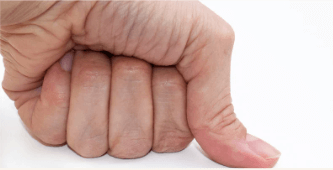
Key Points
The body is made up of building blocks called Proteins.
Collagen is an example of one such protein.
To be more specific, collagen is an example of a connective tissue protein.
Symptomatic Hypermobility often stems from faulty or altered connective tissue proteins.
When this happens then the Hypermobility is part of a Connective Tissue Disorder.
On the outside of the body we may see more flexible joints and certain skin features.
On the inside of the body, this difference in the structure of the connective tissue can affect how many body systems function - e.g. we often see joint hypermobility overlap with Gut and Bladder issues.
In some cases joint hypermobility can be part of another condition, e.g. certain inflammatory conditions or syndromes, so it is important that it is medically evaluated if a child is having symptoms.
ACCURATE Terminology
This is so important!
The word Hypermobility is just a descriptive term - much like saying a person has blue eyes!
It is not a Diagnosis.
When it is suspected that a child/teen’s symptoms may be caused by an underlying connective tissue problem, accurate diagnosis is most important - as is arriving at the correct diagnostic term.
Diagnostic Criteria
The Diagnostic Criteria provide CLINICIANS with a list of clinical features to identify during history-taking and physical examination.
The clinician’s role is to interpret and explain the criteria met (or not met) to families, in order to arrive at the correct diagnostic term for their child.
There are 8 diagnostic categories for children/Paediartics:
4 types of paediatric Generalised Joint Hypermobility (pGJH)
4 types of paediatric Hypermobility Spectrum Disorder (pHSD)
This diagnostic framework for children has been available since May 2023, see references below.
We expect this framework to be updated towards the end of 2026.
The Paediatric Diagnostic Criteria can be used from age 5 yrs to 18 years (or biological maturity.)
A child can still be assessed before the age of 5 years, but we cannot use these 8 terms until after the age of 5 years.
After 18 yrs/biological maturity the adult assessment criteria should be used.
There is also a revision of the adult criteria expected towards the end of 2026.
Paediatrics:
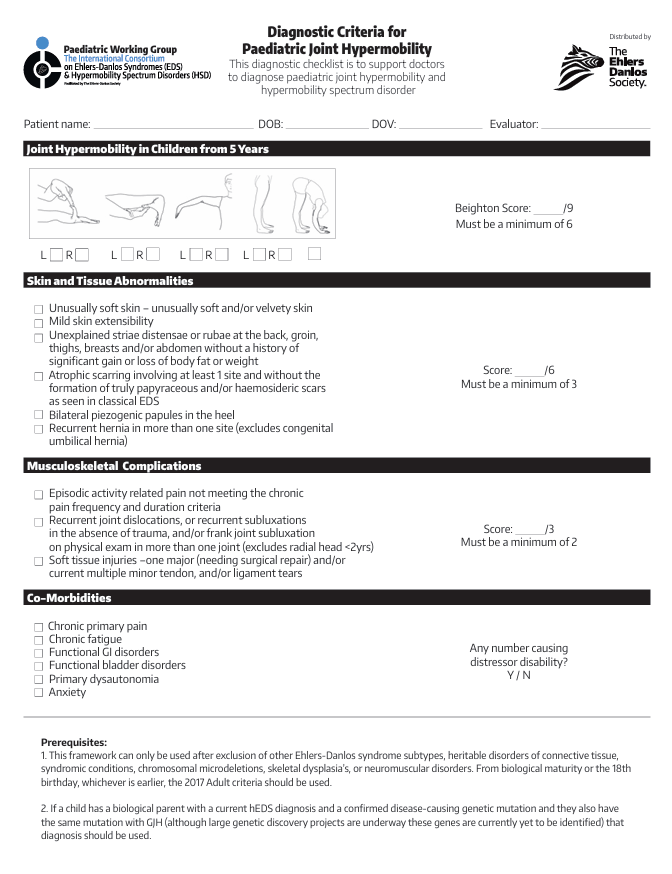
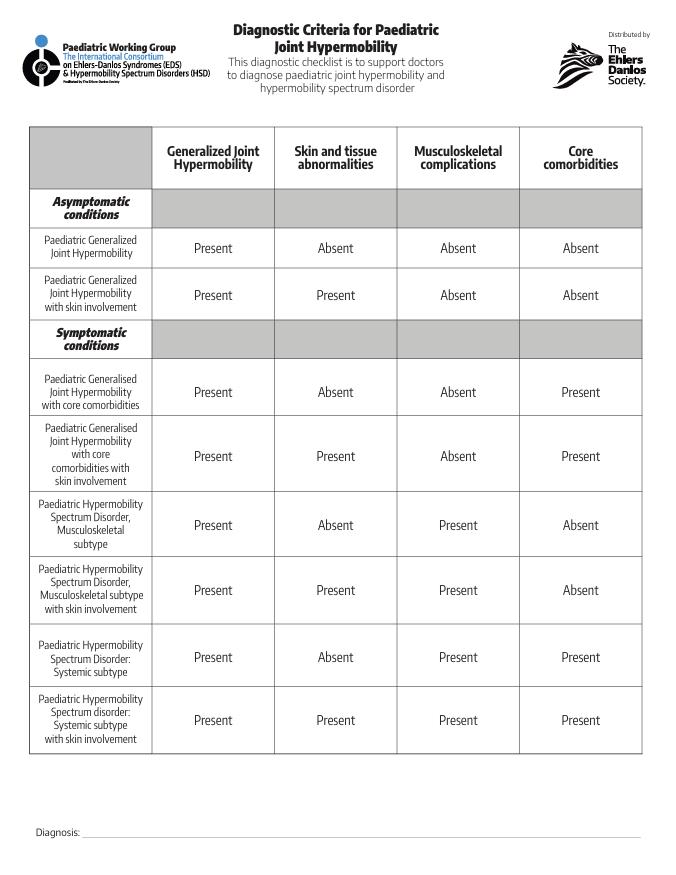
References: 2023 article https://pubmed.ncbi.nlm.nih.gov/37143135/
Ehlers Danlos Society https://www.ehlers-danlos.com/diagnosis/new-diagnostic-framework-for-pediatric-joint-hypermobility-v2/